


- What to do
- Whale watching season
Whale watching season in Cabo San Lucas
The official 2026 to 2027 season, the whales you are most likely to see, and how to choose a permitted boat.
If seeing whales is part of why you came to Cabo San Lucas, the date that matters is the official one. Brochures talk about winter in general. Mexico sets a legal window, and only permitted boats may run whale-watching trips inside it.
For 2026 to 2027, that window in Los Cabos opens on Tuesday, December 15, 2026, and runs to April 30, 2027. Humpback whales are the ones you are most likely to see off the cape. Gray whales also pass this coast, but the close encounters people talk about take place in large saltwater lagoons open to the Pacific, several hours’ drive north of Cabo, not on a boat trip from the marina. We will update this guide if a later official notice changes the dates or the closed zones.
Official dates for 2026 to 2027
Quick facts
- Season
- December 15, 2026 to April 30, 2027Official dates for Los Cabos
- Where
- Cabo San Lucas, San José del Cabo, Cabo PulmoAreas named in the federal notice
- Peak
- Usually January to MarchSightings typically build through late December
- Rules
- Permitted boats onlyUnder the NOM-131 whale-watching standard
The official season for 2026 to 2027 opens on Tuesday, December 15, 2026, and runs to April 30, 2027, in the Cabo San Lucas protected area, San José del Cabo and Cabo Pulmo, according to the SEMARNAT notice in the Diario Oficial, published October 30, 2026. The same notice is the one operators have to follow when they sell a whale-watching trip.
Visit Los Cabos describes the season more loosely as December through April, which tracks when the animals are around. The federal notice is stricter: it is the legal window for taking passengers out to watch whales. If your trip falls in the first two weeks of December, boat rides around the Arch can still be a pleasant morning on the water, but they are marine-life cruises, not permitted whale-watching tours.
Activity usually builds after the opening and is typically strongest from January to March, a pattern a Visit Los Cabos season guide also uses. Early December arrivals are possible, and April can still be worthwhile, but neither end of the season is as reliable as the middle. A sighting is never guaranteed.
Which whales you may see
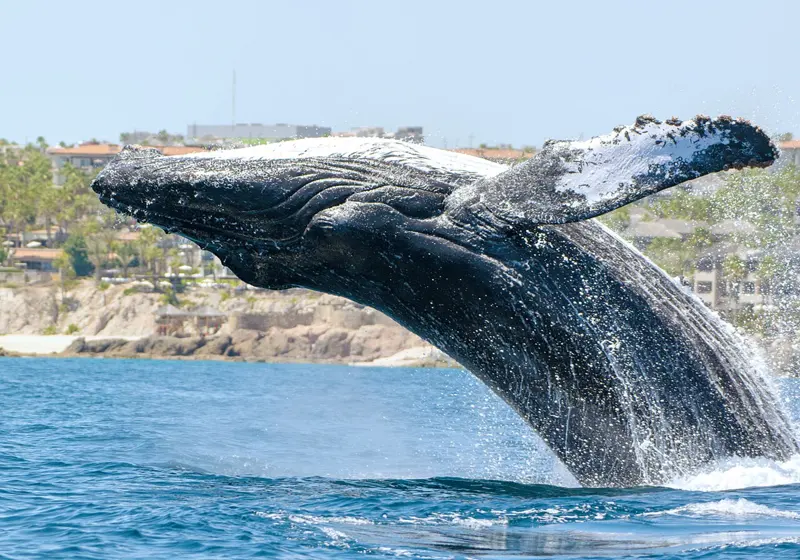
The whale you are most likely to see off Cabo San Lucas and San José del Cabo is the humpback (Megaptera novaeangliae), the one that breaches, slaps its tail and, if you are lucky, lifts its head to look around. Mexico’s whale-watching standard notes that humpbacks concentrate in the Los Cabos region in winter to breed. They spend the colder months in these warm waters and head back toward higher latitudes to feed when the season turns.
Gray whales (Eschrichtius robustus) also use this coastline, but they give birth in large saltwater lagoons that open to the Pacific farther north: Magdalena Bay, Ojo de Liebre and San Ignacio. These are coastal ocean lagoons, not inland lakes, and they are several hours’ drive north of Cabo San Lucas. They are not something you will see on a boat trip from the marina here. CONANP, Mexico’s protected-areas agency, names those coastal lagoons of Baja California Sur as the species’ place of birth and breeding, and the same SEMARNAT notice in the Diario Oficial authorizes whale watching there in winter. In Magdalena Bay (Puerto San Carlos, Puerto Adolfo López Mateos and Puerto Chale) that official 2026 to 2027 season runs from January 1 to April 30, 2027. A regular tour from the Cabo San Lucas marina does not go to those lagoons. If a close encounter in that shallow Pacific lagoon water is what you want, plan it as a separate trip, several hours north of Los Cabos. Our gray whales page is about that migration.
Other species, including blue and fin whales and orcas, are seen in Mexican waters, but they are much less common on a typical outing from Cabo San Lucas. Do not book the day around them.
Where to watch them
Most visitor trips leave from the Cabo San Lucas marina, which sits minutes from the open water at the tip of the peninsula. Boats range from roomy catamarans to smaller pangas. The better choice depends on your stomach, your group and whether you want shade and a bathroom on board, not on which boat can get closest. They all have to keep the same legal distance.
You can also watch from land. a Visit Los Cabos season guide points to Pacific beaches such as Cerritos and Migrino, and to quieter water toward the San José del Cabo estuary and the East Cape. A whale from the sand is a different kind of sighting than a boat trip, but it costs nothing and needs no reservation. Early morning or late afternoon light is usually kinder for photographs, and the Pacific can be windier than the Sea of Cortez side.
On the East Cape, Cabo Pulmo is included in the same official season, with a restricted strip along the coast. It is a longer day from Cabo San Lucas, and it is first of all a protected reef. If you go, treat the whale watching as part of a wider visit, not as a second marina tour.
Zones that stay closed
The federal notice keeps whale-watching activity out of two areas around Cabo San Lucas, because boat traffic there is already heavy:
- The port area, including a 2 km zone around the Arch.
- A 1 km strip of water starting at Punta Ballenas and running out to sea, on the eastern edge of the protected area.
At Cabo Pulmo, the same notice closes a coastal strip of 3.5 km toward open water. These limits apply to whale-watching trips, not to looking from the beach. In practice, a permitted tour will head away from the busy water around the Arch rather than circling Land’s End in hopes of a breach. That is a change worth knowing if older articles still describe the Arch as the usual place to watch whales from a boat.
Rules and how to choose a boat
Whale watching in Mexico is a permitted activity, not a free-for-all. It is governed by NOM-131-SEMARNAT-2010, the federal standard for watching whales without harming them or their habitat. A few rules are useful for passengers, not only for captains:
- The boat must hold a SEMARNAT authorization for non-extractive use of wildlife, and it must display the official identification marker where you can see it while the trip is underway.
- For humpbacks and gray whales, boats have to keep a minimum distance: 60 m for small boats and 80 m for medium and larger ones. Other boats wait farther off, and no more than four boats may stay with the same whale or group, for a maximum of 30 minutes.
- Approach from the side and behind, never head-on and never between a mother and calf. If the whales change course suddenly, dive for longer, or break off feeding, mating or nursing, the boat must leave slowly.
- Swimming, diving, fishing, parasailing, jet skis, kayaks and similar craft are not allowed as a way to watch whales in the authorized zones. Do not feed them, and do not throw anything in the water.
Ask to see the permit or the marker before you board, and do not pressure the crew to close in. The most interesting moments often happen when a whale chooses to approach the boat. The guide is required to brief passengers at the start of the trip. If someone on board is urging the captain to “get closer,” you are already seeing why the rules exist.
What to bring and how to plan
Book once your dates are inside the official season, and book a little ahead in January, February and March, when both the whales and the hotels are busiest. Visit Los Cabos notes that tours tend to fill up. Morning departures are often calmer, which helps if you are not a confident sailor.
Bring sun protection, a hat that will stay on in the wind, water, and a light layer. Even on a warm day the breeze on the water can feel cool, especially on the Pacific side. If you get seasick, take whatever usually works for you before you board, not after the first swell. A camera with a strap is enough; you do not need special equipment, and you should keep your hands free if the boat moves.
Wear shoes you can stand in on a wet deck. If you have small children or anyone who needs a bathroom close by, say so when you book and choose a larger boat. And leave a little room in the day afterward. A trip can run long if the whales are far from the marina, and you will want a quiet lunch more than another reservation on the hour.
Getting here and other winter plans
Most visitors fly into Los Cabos International Airport (SJD), about a 15-minute drive north of downtown San José del Cabo and roughly 40 minutes from downtown Cabo San Lucas. December through March is high season, so it is worth booking flights, rooms and a private airport transfer early.
For monthly temperatures and sea conditions, use our Cabo San Lucas weather page. If you are here over the holidays, the Christmas and New Year’s guide covers the dated events we could confirm, including the fact that whale watching starts on December 15. For other days on the water, the top 10 tours in Los Cabos is a starting point. CaboSanLucas.net does not currently sell its own whale-watching trips, so choose a permitted local operator and check the official dates above before you pay.
This guide was checked on November 26, 2026, against the SEMARNAT notice published in the Diario Oficial on October 30, 2026, and against NOM-131-SEMARNAT-2010. Official dates can be issued again in a later season. If you are reading this after spring 2027, confirm the notice that covers your travel dates.
Hero photograph: a humpback whale breaching off Cabo San Lucas. Photo: Juan Cruzado Cortés, CC BY 4.0, Wikimedia Commons.
Get the CaboSanLucas.net newsletter
Local news, upcoming events and practical tips for your Los Cabos trip. We will also let you know when this guide is updated.
We never share, much less sell, your email, and you can unsubscribe from any email. Privacy policy
Plan the rest of your trip
Ideas for beaches, the marina and day trips, plus private airport transfers booked through CaboSanLucas.net.